Power Tools
Band Saw Basics: What It's Good For and How to Get Started
Band saw basics for beginners: what it cuts better than a jigsaw, blade width and TPI explained, and how to set tension and tracking safely.
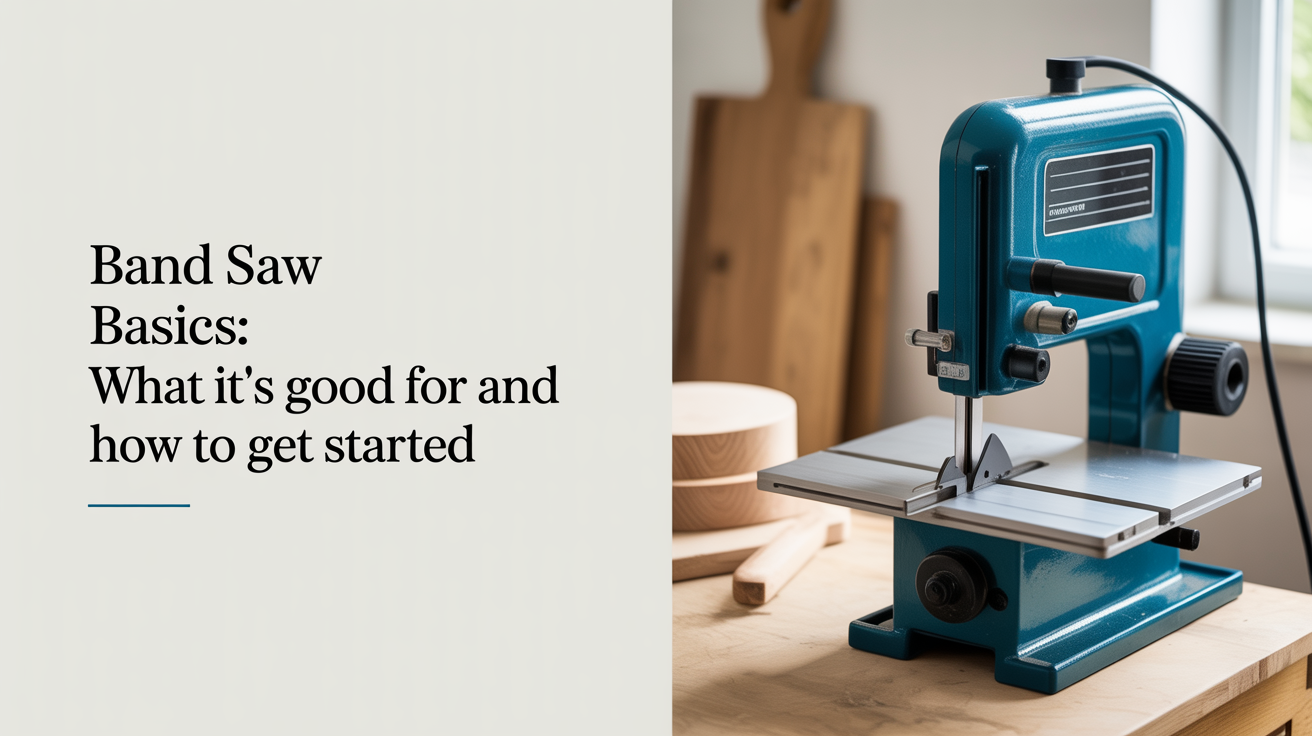
If you're weighing whether a band saw earns a spot in your shop, band saw basics come down to one question: does your work involve curves, thick stock, or cutting boards into thinner slices? If yes, a band saw does things no other saw in a home shop does cleanly. If you mostly cut straight lines in sheet goods or dimensional lumber, you may not need one yet. Here's what it's good for, how to read a blade, how to set it up, and the habits that keep your hands where they belong.
What a Band Saw Does That Other Saws Don't
A band saw uses a continuous loop of blade running over two or three wheels, cutting down through the table in one direction only. That setup gives it three strengths that separate it from everything else in a power tool lineup.
Curves and irregular shapes are where a band saw shines. Because the blade is thin and the cutting motion is continuous rather than reciprocating, you can guide a board through a curve or freeform shape with far more control than a jigsaw offers, especially in thicker material. Chair parts, bracket profiles, cabriole legs, and any shape that isn't a straight edge are band saw territory.
Resawing is the other big one, and it's arguably why serious woodworkers eventually buy a band saw even if they didn't think they needed one. Resawing means cutting a thicker board into two or more thinner boards along its width, standing the board on edge and slicing it like a loaf of bread, useful for matching grain across a project or slicing your own veneer. A table saw can't do it safely at that thickness, and nothing else in a typical shop can do it at all.
The third strength is cutting thick stock generally, curved or not. The blade only cuts on the down stroke, with none of the kickback risk you get from a table saw or circular saw, so a band saw plows through stock that would be dangerous to rip on other tools.
Band Saw vs Jigsaw vs Circular Saw: Where Each One Wins
None of these tools fully replace each other, and knowing which to reach for saves time and frustration.
A jigsaw is more portable and works on material you can't bring to a stationary tool, like a cutout in an installed countertop or a shape in plywood too big for a band saw's throat. It's also the better choice for tight, tricky curves in thin material. See our guide to jigsaw techniques for curves and cutouts for more.
A circular saw wins for long, straight cuts, especially breaking down full sheets of plywood or MDF where a band saw's table and throat depth can't accommodate the material. Paired with a straightedge, it's more accurate for long rips than most people expect. See circular saw basics for accurate cuts for how to get straight, splinter-free results.
A band saw wins when the cut is curved, the stock is thick, or you're resawing. Think of the three as a set: circular saw for breaking down sheet goods, jigsaw for portable curved work in thin material, band saw for stationary curved work, thick stock, and resawing. If you're still sorting out which tools deserve bench space as you build a shop, our comparison of hand tools vs power tools and when each one wins is a useful next stop.
Blade Width and Teeth Per Inch, Explained Simply
Band saw blades come in a range of widths and tooth counts, and picking one isn't complicated once you know what each number does.
Blade width controls how tight a curve you can cut. A narrow blade, 1/8 inch or 1/4 inch, turns a tighter radius because it has less material resisting the twist. A wide blade, 1/2 inch to 3/4 inch or more, can't turn as tight a curve, but tracks straighter and resists wandering, exactly what you want for resawing.
Teeth per inch, shortened to TPI, controls feed rate and finish. A lower TPI blade, in the 3 to 6 range, has bigger gouges between teeth that clear sawdust fast, which matters in thick stock like a resaw cut. A higher TPI blade, 10 and up, leaves a smoother cut on thin material but clogs faster in thick wood since there's less room to clear chips.
| Task | Blade width | TPI range |
|---|---|---|
| Tight curves, scrollwork | 1/8" to 1/4" | 10 to 14 |
| General curves, everyday cuts | 3/8" | 6 to 10 |
| Resawing thick stock | 1/2" to 3/4" | 3 to 4 |
| Cutting metal or thin plastic | Varies | 14 to 24 |
If you only own one blade, a 3/8-inch blade around 6 TPI is a reasonable all-purpose choice that handles moderate curves and general cutting without being specialized for either extreme.
Setting Tension and Tracking Before You Make a Cut
Every band saw needs its blade tensioned and tracked correctly before you feed a board through it. Skipping this step is the most common reason beginners get bad cuts, wandering lines, or a broken blade.
Tension keeps the blade rigid enough to cut straight instead of flexing. Frame gauges are often optimistic, so many woodworkers set tension by feel: a properly tensioned blade should deflect only slightly, maybe a quarter inch, when pushed sideways between the guides. Too loose and it drifts off your line and cuts a curved surface when you wanted flat. Too tight and you shorten the blade's life and stress the wheels and bearings.
Tracking means the blade rides in the center of the wheels, not creeping toward the front or back edge. With the saw unplugged, turn the top wheel by hand while watching the blade, and adjust the tracking knob (usually behind the top wheel) until it settles in the middle of the wheel's crown. Recheck any time you switch blade widths.
Once tension and tracking are set, adjust your blade guides, the small blocks or bearings above and below the table, so they sit close without pinching. This keeps the blade from twisting mid-cut, which matters most when resawing, where any twist shows up as a wavy cut through the whole board.
Core Safety Habits to Build From Day One
A band saw is one of the safer stationary power tools in a shop, since there's no spinning blade throwing material back at you the way a table saw or router can. That doesn't mean it's forgiving of bad habits.
Keep a push stick within reach and use it any time your fingers would otherwise come within a few inches of the blade, especially on narrow rips or the last stretch of a cut. Your hands should never be in line with the blade's path; if a cut requires your hand to travel toward the blade, reposition the board or your grip so you're pushing from the side instead.
Set the blade guard, sometimes called the guide post, close to the top of your workpiece before you start, within a half inch of the material. A guard set high above a thin board exposes more blade than the cut requires, and that's exactly where accidental hand contact happens.
Stand slightly to the side of the blade line rather than directly behind it, keep the table clear of offcuts and clamps that could catch the workpiece, and never back a board out of a partway-finished resaw cut. Turn off the saw and let the blade stop completely before pulling material back.
Benchtop or Stationary: What Fits a Home Shop
Benchtop band saws are smaller, lighter, and cheaper, a reasonable starting point if shop space is limited or your projects rarely involve thick resawing. They typically offer less resaw capacity, often 3 to 6 inches, and less motor power, so they can bog down in dense hardwood.
Stationary band saws, the floor-standing models, offer more resaw capacity, often 8 inches or more, steadier power under load, and larger tables. They take up real floor space and cost more, which is the tradeoff.
For a one-car-garage shop just getting started, a benchtop model handles curves, general cutting, and moderate resawing fine. Once resawing your own veneer becomes routine, a stationary saw with real resaw capacity starts to pay for itself.
Frequently Asked Questions
Can a band saw replace a table saw?
Not really. A band saw is better for curves, thick stock, and resawing, but a table saw is faster and more accurate for repeated straight rips and crosscuts with a fence and miter gauge. Most shops eventually want both.
What size band saw is good for a beginner?
A benchtop model with at least a 9-inch to 10-inch throat and a few inches of resaw capacity covers most beginner projects, including curved parts and moderate resawing. Upgrade to a stationary saw once you know what your projects actually demand.
Why does my band saw blade keep drifting off the line?
Drift usually comes from incorrect tension, a dull blade, or guides set too far from the blade. Check tension first, since it's the most common culprit, then inspect the teeth for dulling or damage before blaming your technique.
Is a band saw safer than a table saw?
Generally yes, since the cutting action is downward and continuous rather than a spinning blade capable of kickback. That said, safer doesn't mean safe without care. Keep hands clear of the blade line, use push sticks, and set the guard close to your material every time.
Can I cut metal on a wood band saw?
Standard wood-cutting band saws run too fast for most metals and will dull or overheat a blade quickly. Cutting metal needs a dedicated metal-cutting band saw with a slower speed range, or a wood saw modified with a speed reducer and the right blade. Check your saw's rated speed range before trying it.