Power Tools
Jigsaw Techniques for Curves and Cutouts
Learn how to use a jigsaw for curves, straight cuts, and interior cutouts. Covers blade selection, setup, and technique for beginners.
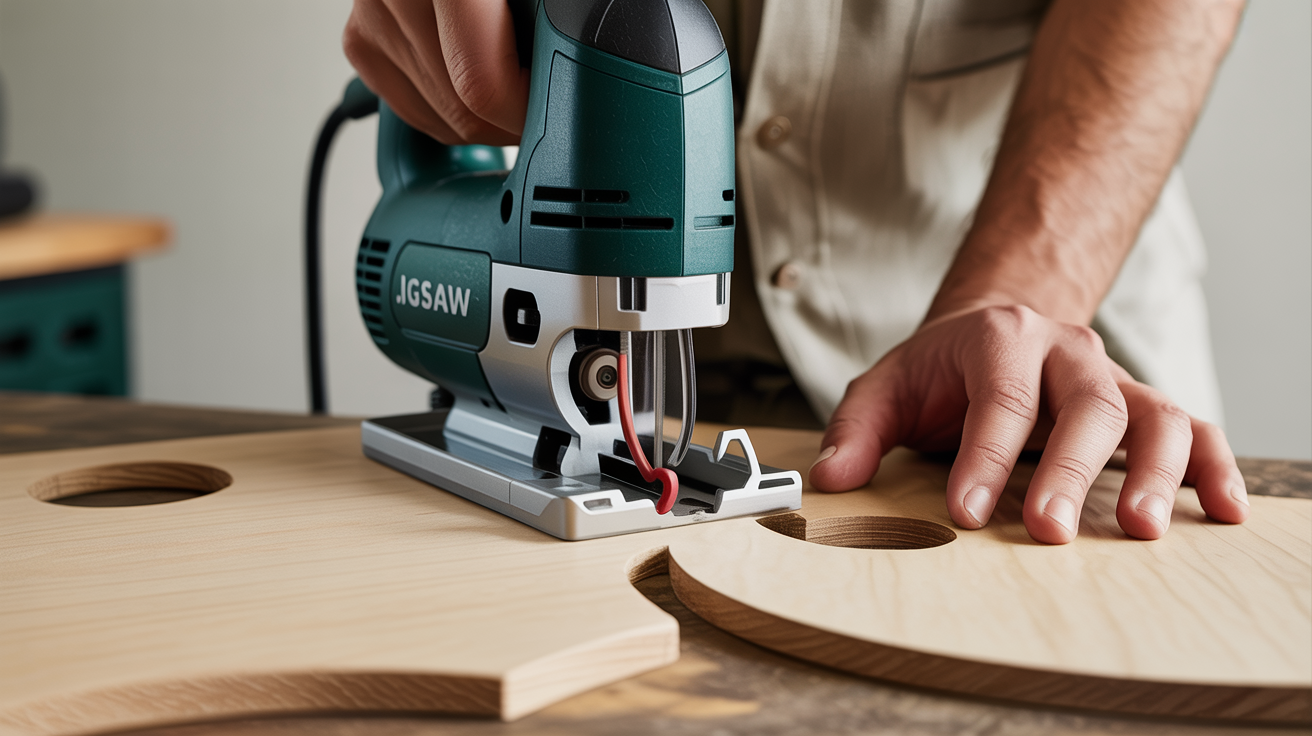
A jigsaw is one of the most useful tools in a beginner's shop because it can cut curves, straight lines, and interior holes that no other portable saw can handle. If you know how to set it up and guide it correctly, the results are clean and repeatable.
What a Jigsaw Actually Does
A jigsaw drives a narrow blade up and down at high speed while you push the tool forward through the wood. That reciprocating motion is what lets it follow curves: unlike a circular saw, which needs room to pivot a large blade, a jigsaw blade is thin enough to change direction gradually.
The shoe (the flat metal plate on the bottom) rests on your workpiece and keeps the blade perpendicular to the surface. Most jigsaws have a variable-speed trigger and an orbital setting that controls how aggressively the blade attacks the cut. For most woodworking, keep the orbital setting low or off; you get cleaner edges that way, at the cost of a slower cut.
Choosing the Right Jigsaw Blades
Blade selection matters more than most beginners expect. The wrong blade produces rough edges, burning, or a cut that wanders.
| Blade teeth per inch (TPI) | Best for |
|---|---|
| 6-8 TPI | Fast cuts in thick softwood and plywood, rough edges OK |
| 10-12 TPI | General woodworking, decent edge quality |
| 14-20 TPI | Thin sheet goods, MDF, laminates, cleaner finish |
| Reverse-tooth blade | Face-down cuts on veneer or laminate (teeth cut on the downstroke) |
A few practical rules:
- Higher TPI = slower cut, cleaner edge. For cabinet-quality work, a 14-TPI blade in 3/4-inch plywood leaves an edge that needs minimal sanding.
- Narrow blades cut tighter curves. A blade that is 1/4 inch wide can follow a radius of about 1 inch. A wider blade needs a gentler arc.
- Replace blades early. A dull blade produces a ragged, burned edge and makes the saw work harder. Blades are cheap; sandpaper and frustration are not.
For jigsaw blades, the shank type has to match your tool. T-shank blades (the most common today) lock in without a screwdriver. U-shank blades require a tool to swap. Check your manual if you are unsure.
How to Set Up and Make a Basic Cut
Before the blade touches wood, get the setup right.
Mark your line clearly. A thick pencil line is hard to follow precisely. Use a sharp pencil or a marking knife and trace just inside the waste side of the line, so the blade removes the line itself.
Support the workpiece. The jigsaw cuts on the upstroke (for standard blades), so it lifts the wood slightly. If the board can flex, the cut chatters. Support both sides of the cut line with sawhorses or a sheet of rigid foam under the whole panel. Clamp the workpiece so it cannot shift.
Set the shoe flat. Before you start, press the shoe firmly against the wood. If there is a gap at the front or back, the blade enters at an angle and the edge will be beveled.
Start the saw before touching the wood. Bring the blade up to full speed, then advance it into the material. Starting under load bogs the motor and can snap a blade.
Let the saw set the pace. Push forward steadily enough that you can hear the motor working, but not so fast that you feel resistance or see the blade flex. If the blade is bending sideways, you are pushing too hard.
For straight cuts, clamp a piece of straight scrap as a fence along the cut line. Guide the shoe edge against it the same way you would use a fence on a circular saw for accurate cuts.
Jigsaw Cutting Curves
Curves are where the jigsaw earns its keep, but they require a slightly different approach than straight cuts.
Slow down on tight turns. If the radius is small, ease the forward pressure and let the blade clear the kerf. Rushing a tight curve bends the blade and produces a beveled edge.
Pivot, do not steer. Think of guiding the shoe around the curve rather than pushing the blade sideways. The blade follows the direction the shoe points.
Relief cuts for tight curves. On a very tight inside curve, make a series of straight relief cuts from the waste edge to just short of the cut line before following the curve. Each straight cut creates a small wedge of waste that falls away as the blade passes, so the blade has room to turn without binding.
Score the face on veneer ply. Even a fine-tooth blade can chip the top veneer on the upstroke. Score the cut line with a utility knife first, then cut just outside the score. The scored line acts as a stop for tear-out.
Cutting a Full Circle
Cutting circles jigsaw-style is much easier with a simple trammel jig. Screw a strip of 1/4-inch plywood to the shoe (with one of the shoe's existing screw holes if possible, or with a small bolt), drill a pivot hole at the radius distance from the blade, and press a nail through the pivot hole into the center point of your circle. Rotate the saw around the nail. The cut is perfectly round every time, no freehand involved.
For circles smaller than about 4 inches in diameter, the trammel gets awkward. At that size, drill a blade-entry hole inside the waste area, start the jigsaw inside the circle, and cut freehand to a circle drawn with a compass.
Interior Cutouts (Plunge Cuts)
A sink cutout in a countertop, a speaker hole in a cabinet, an outlet opening in a panel: all of these require starting a cut in the middle of a board with no edge to begin from.
The standard method is to drill a blade-start hole. Use a 3/8-inch or larger bit to drill just inside the cut line. Insert the blade into the hole and start cutting. The hole gives the blade enough clearance to reach full depth before it starts moving laterally.
Some jigsaws support a plunge cut without a pre-drilled hole: tilt the saw forward so only the front edge of the shoe touches the wood, start the blade, and slowly lower the back of the shoe until the blade is through. This takes practice and only works on material 3/4 inch thick or less. Until you are comfortable with the technique, the drill-hole method is more reliable and safer.
Clamp the cutout piece before the final pass. On a sink cutout, the waste piece is large and heavy. If it falls free suddenly near the end of the cut, it can bind the blade or crack the panel. Clamp a piece of scrap across the opening so the waste cannot drop until you remove the clamp.
Safety Basics
- Keep fingers well away from the blade path. The blade is short but the tip is exposed.
- Wear eye protection. Jigsaw dust ejects upward from the cut line, directly toward your face.
- Unplug or remove the battery before changing blades. The trigger can be bumped.
- Never reach under the workpiece while the saw is running. The blade extends below the shoe.
- Let the blade stop completely before setting the saw down.
The jigsaw complements other power tools rather than replacing them. For long, straight rips, a circular saw handles accurate cuts faster. For edge shaping and profiling once you have a rough curve cut, a router gives you cleaner results. After cutting, a random orbital sander smooths jigsaw edges quickly without removing too much material.
Frequently Asked Questions
Why does my jigsaw leave a rough edge on plywood? The most common cause is a blade with too few teeth per inch. Switch to a 14-TPI or higher blade. The second cause is feeding too fast: slow down and let the blade cut rather than forcing it through. Scoring the cut line with a utility knife before cutting also reduces tear-out on veneer faces.
Can I cut a straight line with a jigsaw? Yes, but you need a guide. Clamp a straight board parallel to your cut line and ride the edge of the shoe against it. Without a guide, freehand straight cuts wander. For long, straight rips a circular saw is generally the better choice, but a jigsaw with a fence cuts straight lines well enough for most projects.
What causes a jigsaw blade to bend or drift during a cut? Blade drift usually means the blade is dull, the TPI is too low for the material, or you are pushing too fast. A dull blade takes the path of least resistance rather than following your line. Replace the blade and ease off the forward pressure.
How do I cut a hole in the middle of a board without cutting in from the edge? Drill a starter hole just inside your cut line using a drill bit wide enough to fit the jigsaw blade (at least 3/8 inch). Insert the blade, start the saw, and follow the cut line from there. This is the standard method for sink cutouts, speaker holes, and outlet openings.
What thickness of wood can a jigsaw cut? Most jigsaws handle softwood up to about 4 inches and hardwood up to about 2.5 inches, depending on the blade length and motor size. For typical sheet goods (3/4-inch plywood or MDF), any corded or mid-range cordless jigsaw has more than enough capacity. The practical limit for clean results is usually thinner than the tool's maximum rated cut depth.