Power Tools
Circular Saw Basics for Accurate Cuts
Master how to use a circular saw for straight, clean cuts in plywood and lumber with blade depth, guide rails, and kickback prevention tips.
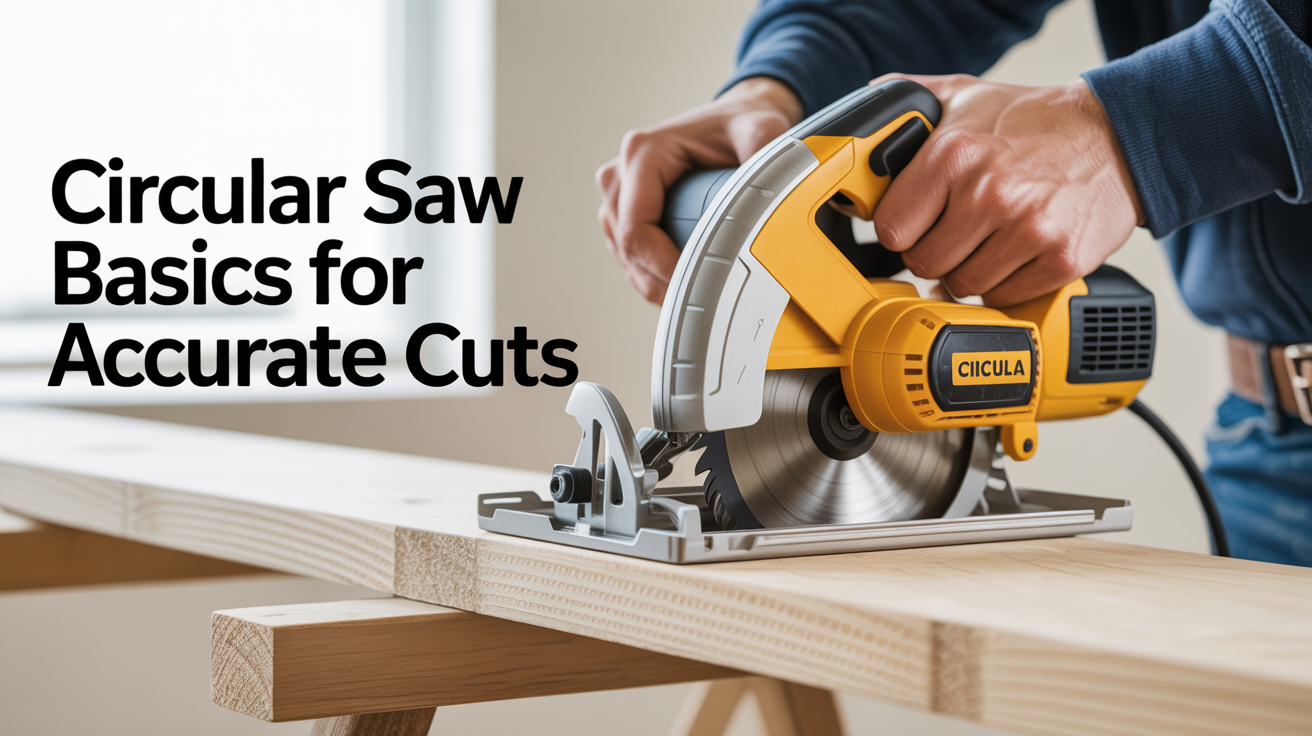
A circular saw is the first power tool many woodworkers actually use, and for good reason. It handles sheet goods, dimensional lumber, and rough rip cuts faster than almost anything else in the shop. Getting accurate, splinter-free results takes a bit of setup, but once you understand the fundamentals, the saw earns its place on every project.
At a Glance
- Set blade depth so no more than 1/4 inch of blade extends below the workpiece. Shallower is safer and cleaner; deeper only invites kickback.
- The blade cuts on the upstroke, so tearout happens on the top face. Whatever side matters most should face down.
- Support both sides of every cut and let the offcut fall free. Pinching the blade between a sagging piece and the main workpiece is the single most common cause of kickback.
- Match blade tooth count to the material: fewer teeth for speed on rough lumber, more teeth for clean cuts on plywood and finish work.
- A dull blade is a safety issue, not just a quality one. It needs more force to feed, which raises the odds of a kickback.
- Always start a cut with the shoe resting on the workpiece and the blade clear, then bring the saw to full speed before advancing.
Setting Blade Depth Correctly
Before you cut anything, set the blade depth. The standard rule: the blade should extend no more than 1/4 inch below the bottom face of your workpiece. For a 3/4-inch board, you want roughly an inch of blade exposed total. A shallow depth reduces kickback risk, limits the amount of blade arc spinning in open air, and generally produces a cleaner cut.
| Material Thickness | Blade Depth Setting | Blade Exposed Below Work |
|---|---|---|
| 1/2 in (plywood) | ~3/4 in | ~1/4 in |
| 3/4 in (dimensional lumber) | ~1 in | ~1/4 in |
| 1-1/2 in (2x stock) | ~1-3/4 in | ~1/4 in |
To adjust, loosen the depth lever on the back of the shoe, lower the base until the blade sits at the right depth, then lock it back down. Check it with a scrap piece before committing to your good material.
Which Face Goes Down
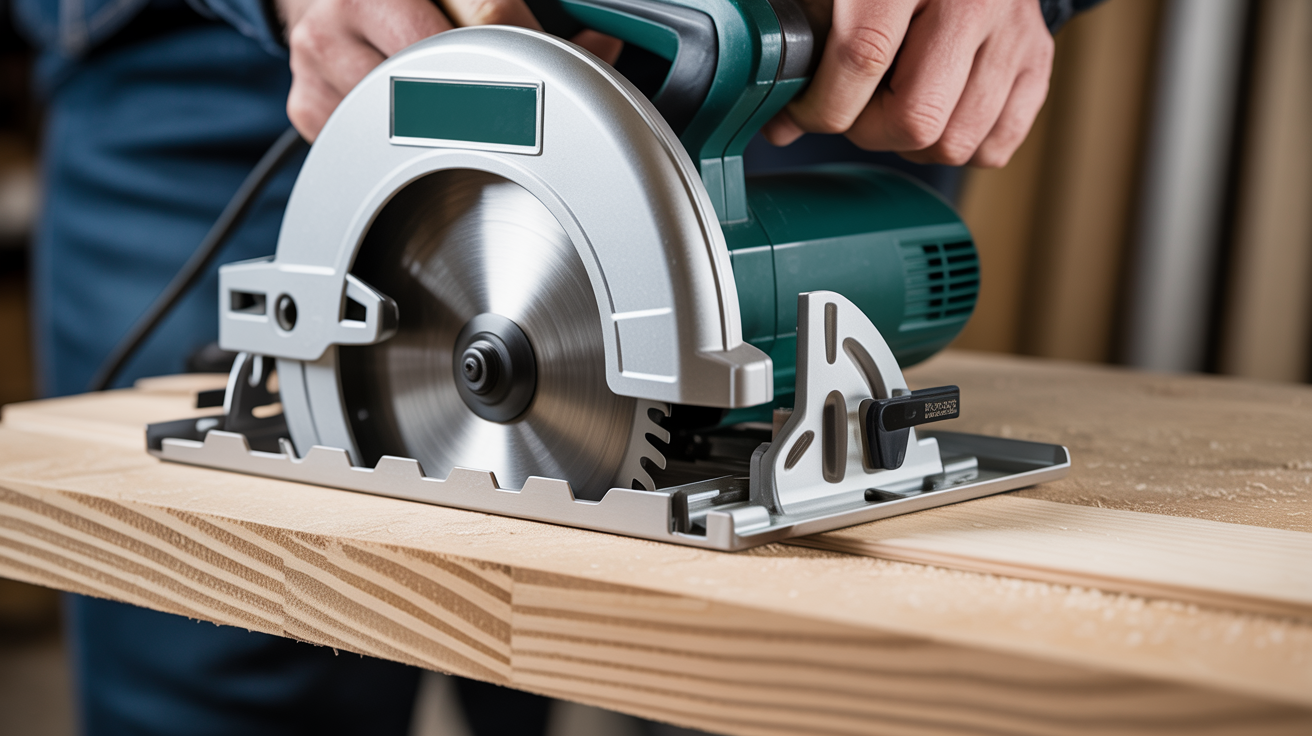
This is the detail that trips up beginners the most. On a circular saw, the blade cuts on the upstroke, which means tearout happens on the top face. Whatever side you care about should face down.
Cutting a piece of furniture-grade plywood? Set the good face down, even if it feels awkward to mark and follow the line from the "wrong" side. For finish cuts on hardwood, the same logic applies. Tearout on the underside can be sanded or hidden; splintered show surfaces are harder to recover.
If you need clean cuts on both faces, score the cut line with a utility knife first. That severs the surface fibers before the blade reaches them.
Supporting the Work to Prevent Kickback
Kickback is the saw's most dangerous behavior. It happens when the blade binds in the kerf, usually because the offcut or the main piece sags and pinches the blade from the sides. The saw gets thrown back toward you fast. The Power Tool Institute, an industry safety organization representing major power tool manufacturers, flags the circular saw specifically as one of the most commonly used and most commonly misused saws in both professional and home shops, which is exactly why the basics below are worth doing every time, not just when you remember to.
Two habits prevent it:
- Support both sides of the cut. Set the workpiece on two sawhorses or a sacrificial sheet of rigid foam insulation on the ground. The foam method is especially good for breaking down full 4x8 sheets because you don't need to worry about clearance.
- Let the offcut fall free. Don't try to catch it or hold it up at the end of the cut. If the offcut can't sag away cleanly, it will pinch.
Always keep two hands on the saw. Your left hand stays on the front handle or the body of the tool, never near the blade path. Wear eye and ear protection. Unplug (or remove the battery) before changing blades.
The riving knife or blade guard that ships with your saw exists for a reason. Some experienced woodworkers remove the guard for certain cuts, but leave it in place until you understand exactly what situations require it off and why.
Making Straight Cuts with a Guide
Freehand circular saw cuts drift. Even experienced woodworkers rarely follow a pencil line accurately for more than a foot or two without guidance. A straight edge clamped to the work is the simplest fix.
A straightedge guide works like this: measure the distance from the left edge of your saw's shoe to the blade, then clamp a straight board or aluminum level that same distance away from your cut line. Run the shoe against the straightedge through the whole cut.
A shop-made T-square guide is even faster for crosscuts on sheet goods. Scrap plywood, a couple of screws, and a few minutes of setup gives you a repeatable 90-degree guide you can clamp anywhere on a sheet.
For long rip cuts on plywood, a track saw guide rail is the premium option. The rail has a rubber strip on the underside that grips the work, and a splinter guard built into the track lip. You set the rail on the line and the saw follows it precisely. Guide rails are an investment, but if you break down a lot of sheet goods, the time savings and cut quality justify the cost.
Blade Choice: Tooth Count Matters
The wrong blade produces torn, rough cuts regardless of technique. Here is a quick reference:
| Blade Type | Tooth Count | Best For |
|---|---|---|
| Framing / demo | 24T | Rough lumber, structural cuts, speed over finish |
| General purpose | 40T | Dimensional lumber, mixed-grain wood |
| Plywood / finish | 60T | Furniture-grade plywood, MDF, veneers |
| Fine crosscut | 80T | Hardwood finish cuts, minimal tearout |
Most beginners get by with a 40T general-purpose blade and a 60T plywood blade. The 24T framing blade cuts fast but leaves a rough edge you will spend time cleaning up on anything that shows.
Dull blades are a safety hazard, not just a quality problem. A dull blade requires more force to feed, increases heat and friction, and makes kickback more likely. If the saw is burning the wood or you need to push hard, replace the blade. As a rough guide, a 40T carbide blade cutting mostly plywood and softwood will typically hold a usable edge for several hundred linear feet of cutting before it needs sharpening or replacement, less if it repeatedly hits screws or grit-laden reclaimed lumber.
Common Mistakes and How to Fix Them
Drifting off the line. Usually a guide problem. Clamp a straightedge and let the shoe register against it instead of trying to eyeball the pencil line.
Blade binding mid-cut. The work is sagging and pinching the blade. Stop the saw, support the workpiece better, and restart.
Tearout on the show face. Blade is upside down (yes, it happens), or blade tooth count is too low for the material. Check that the blade teeth at the front of the saw point upward toward the shoe.
Motor bogs down. Feed rate is too fast for the blade and material combination. Slow down or switch to a lower tooth count blade for rough cuts.
For finish detail work after rough cuts, a router cleans edges and profiles fast. See how to use a router as a beginner for a walkthrough of that process. Before you reach for the circular saw on a project, it also helps to be comfortable with cordless basics covered in how to use a drill and driver like a pro. And once you have your cuts made, surface prep often comes down to getting started with a random orbital sander.
Frequently Asked Questions
Do I need a track saw, or will a straightedge work?
A clamped straightedge does the same job as a guide rail for occasional cuts. Track saws are faster to set up for repeated cuts on sheet goods and leave a cleaner edge with no clamping marks, but they are not a requirement. Start with a shop-made guide and upgrade later if you find yourself breaking down sheets regularly.
Why does my circular saw leave burn marks on the wood?
Burn marks usually mean a dull blade, a blade with too many teeth for the material (too much friction, not enough chip clearance), or a feed rate that is too slow. Try increasing your feed speed slightly and check how long it has been since you replaced the blade.
How do I cut a straight line without a guide?
Score the line deeply with a marking knife first so there is a physical groove to follow. Then use the notch on the front of the saw shoe (the kerf indicator) as a guide, keeping it lined up with the scored line. It takes practice and works better for shorter cuts than long rips.
What is the safest way to start a cut?
Position the front of the shoe on the workpiece before you pull the trigger, with the blade clear of the material. Bring the saw to full speed, then advance into the cut. Never plunge a spinning blade into the middle of a board unless your saw is specifically designed for plunge cuts.
Can I use a circular saw to cut curves?
Circular saws make straight cuts. For curves, use a jigsaw. A circular saw forced into a curve will bind, kickback, and ruin the cut.
How often should I check or adjust the base plate for square?
Check it any time you swap blades and again every few months of regular use. Use a small square against the blade and the shoe with the saw unplugged. A base plate that's drifted even a degree or two out of square shows up as a visible bevel on cuts that are supposed to be a clean 90 degrees, and it's a common, overlooked cause of parts that don't fit together squarely later in a build.
Is a cordless circular saw as capable as a corded one for shop work?
For most home shop tasks, a mid-to-high-capacity cordless saw (typically 6.5 to 7.25 inch blade, a battery in the 4 to 6 amp-hour range) keeps up fine with breaking down sheet goods and framing lumber for an afternoon. Corded saws still win for all-day production cutting or when you're feeding thick stock continuously, since they never need a battery swap. For occasional weekend projects, cordless is usually the more convenient choice.