Getting Started
How to Set Up a Small Garage Workshop
Transform a one- or two-car garage into a functional woodworking shop with smart layout, storage, and electrical planning.
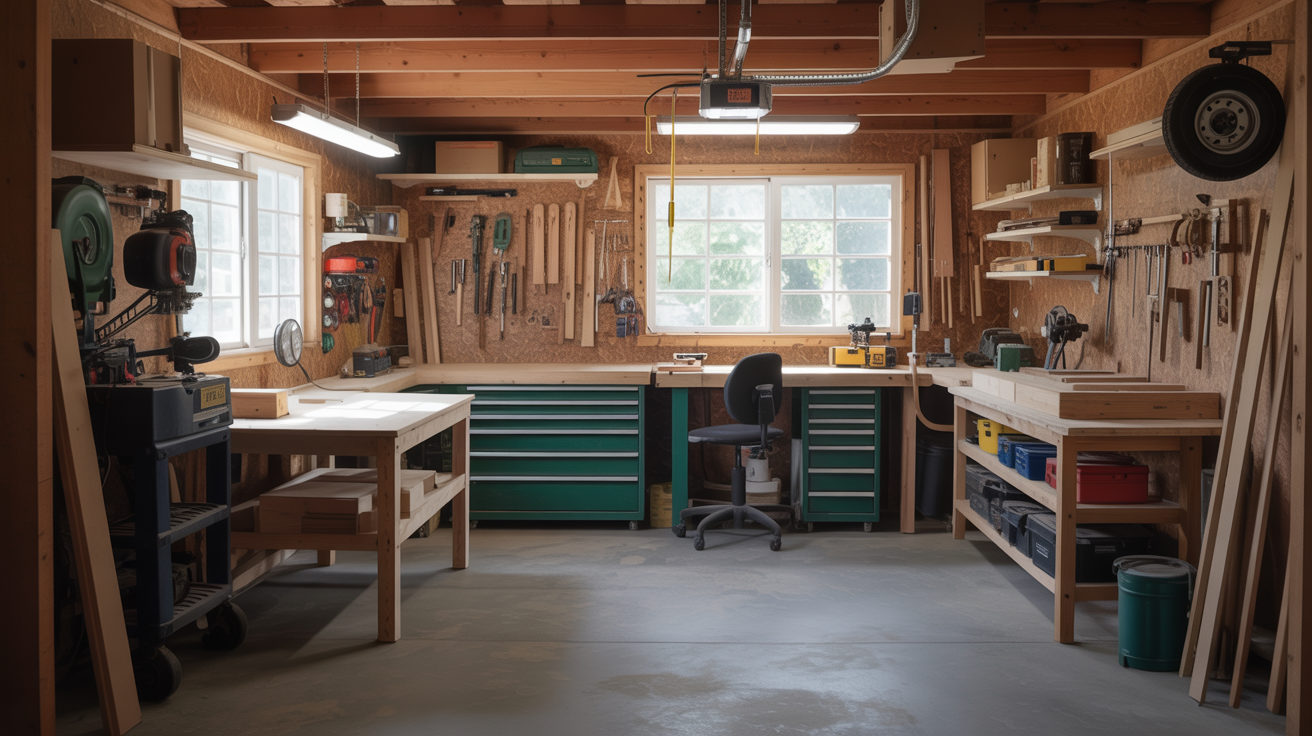
A single-car garage gives you roughly 200 square feet to work with. That's enough room for a solid garage woodworking shop if you plan the space before you start dragging tools in. The decisions you make early, especially about workflow, electrical, and dust, will either open the space up or make it miserable to use.
Plan Your Workflow Before You Place a Single Tool
The most common mistake in a small workshop setup is placing tools where they fit rather than where they belong in a sequence. Woodworking moves through stages: rough lumber comes in, gets cut down to size, then jointed or planed, then assembled, then finished. Each stage needs a landing zone.
A simple zone map for a two-car garage:
| Zone | What Goes There |
|---|---|
| Entry / lumber storage | Sheet goods, dimensional lumber, drying space |
| Rough milling | Table saw, miter saw, thickness planer |
| Joinery and fitting | Workbench, drill press, router table |
| Assembly | Open floor space, clamp rack nearby |
| Finishing | Separate corner with ventilation, away from sawdust |
Keep the car in mind. If you need to park at night, every tool on wheels makes that possible. Mobile bases under the table saw and bandsaw let you push them against the wall and reclaim the center aisle. A folding workbench or a wall-mounted bench that drops down on hinges solves the bench problem without eating permanent square footage.
Draw the layout on paper first, to scale. Mark the garage door swing, the entry door, and any windows. Tape the outlines on the floor with painter's tape before you commit to positions. Walk through the sequence with scrap lumber in hand. You'll find the conflicts immediately.
The Workbench: Your Most Important Fixed Point
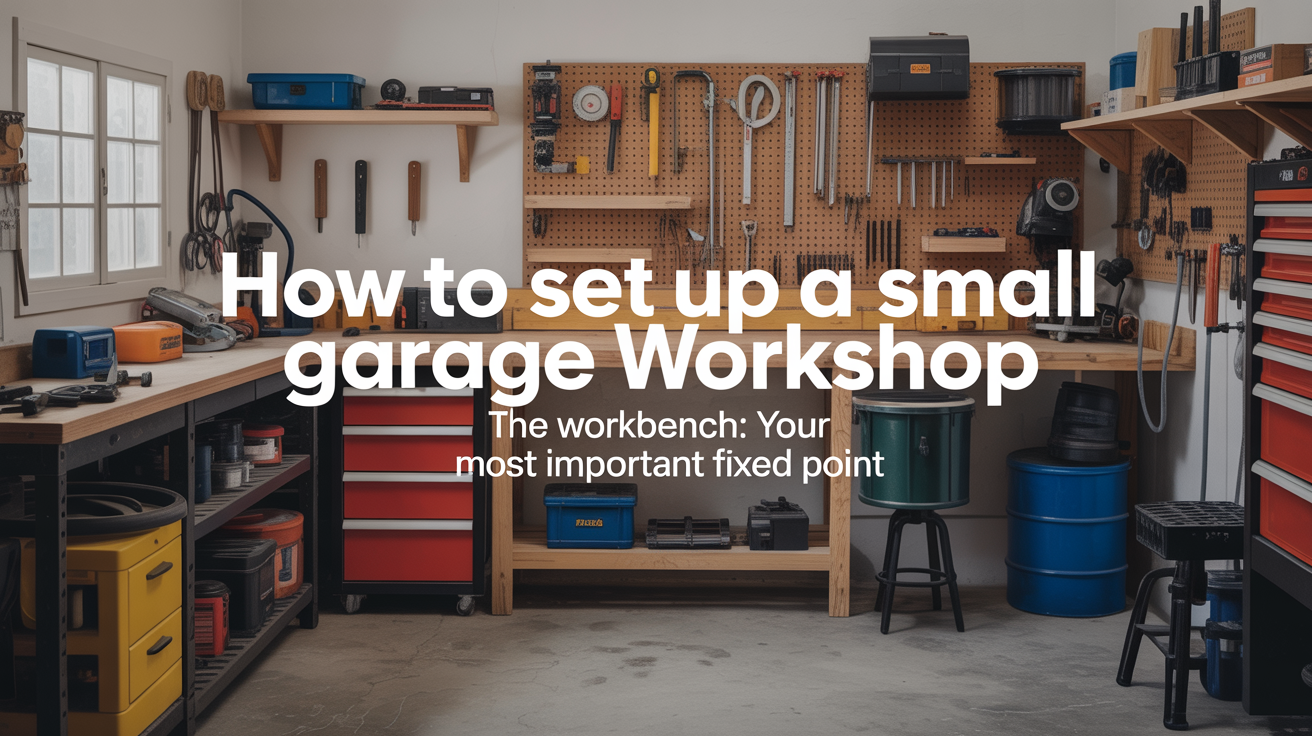
A good bench anchors the whole shop. For a small space, a bench that runs along the back wall (opposite the garage door) keeps the center open. Aim for 24 to 30 inches deep and at least 6 feet long if you can manage it. Height matters more than most beginners expect: stand straight, let your arms hang, measure from the floor to your wrist. That's your bench height.
A front vise and a row of dog holes give you flexible clamping without clamps stacked everywhere. You don't need a $2,000 Roubo to start. A torsion box top on a simple base is flat, stable, and cheap to build. If you're just getting started with woodworking, build the bench as your first real project.
Resist the urge to cover the bench top with tools. The bench surface is your workspace, not a shelf.
Storage: French Cleats and Pegboard Beat Freestanding Shelves
Floor space is the scarce resource in a home workshop. Vertical wall storage multiplies what you have.
French cleats are a system of interlocking 45-degree strips ripped from plywood. Screw a field of them across one or two walls and hang custom holders, shelves, and bins anywhere you like. Rearranging takes seconds. The tools that see daily use go at eye level; infrequent ones go higher or lower.
Pegboard works too and costs less, though it holds lighter tools and the hooks migrate over time. A combination approach is practical: pegboard for hand tools and small accessories, French cleats for heavier holders like router bit cases and power tool brackets.
A basic wall storage checklist:
- Hand tools (chisels, saws, mallets) on pegboard or a tool cabinet
- Clamps on a dedicated clamp rack (a horizontal bar with vertical pegs)
- Router bits and drill bits in indexed drawers or labeled bins
- Sheet goods stored vertically in a dedicated slot or lean-to rack
- Finishing supplies in a metal cabinet, away from heat sources
Lumber on the floor is a trip hazard and a moisture problem. Build or buy a simple wall-mounted lumber rack as early as possible.
Dust and Air Quality
Sawdust is the part of a garage woodworking shop that new builders underestimate. A table saw throws chips across the room. A random-orbit sander generates fine particles that float for hours and coat everything, including your lungs.
Two-stage dust collection is the standard approach: a shop vac or small dust collector captures at the source (connected directly to the tool), while an ambient air filtration unit hung from the ceiling cleans the air of what escapes. For a small garage, a 1.5 HP single-stage collector handles most stationary tools. A shop vac with a cyclone separator keeps the filter cleaner longer and extends its life significantly.
Filters matter. A HEPA or at least 1-micron filter on your shop vac catches the particles that hurt you. Blowing dust into the air with a leaf blower or compressed air is counterproductive in a small space.
Ventilation and dust are also a fire concern. Finish rags soaked in oil-based products, including danish oil, teak oil, and many varnishes, can spontaneously combust if wadded up and left in a pile. Spread them flat to dry outdoors, or drop them in a metal can with a tight lid filled with water. This is not hypothetical. Fires from oily rags are a documented and preventable cause of shop losses.
Power and Lighting
Most garage circuits are 15-amp shared circuits not built for stationary power tools. A table saw, a dust collector, and a shop light on the same circuit will trip the breaker constantly, and extension cords under load create heat and voltage drop that shortens tool motor life.
The practical minimum for a functional small workshop setup:
- One dedicated 20-amp circuit for the table saw
- One dedicated 20-amp circuit for the dust collector
- General lighting and small tools on a separate circuit
If your garage has a sub-panel, adding circuits is straightforward work for an electrician and worth the cost. If not, at minimum plug your table saw directly into the wall and run nothing else on that outlet simultaneously.
For lighting, 50 foot-candles at bench level is the baseline; 100 is better for detail work. LED shop lights in the 4,000-5,000 Kelvin range (cool white, close to daylight) reduce eye strain and show wood color accurately. Hang them in a grid rather than a single center fixture. Add a task light over the bench. Shadows under cabinets and around the table saw blade are where fingers get into trouble.
Making It Work Around the Car
A garage shop that forces you to choose between your car and your tools will lose to the car eventually. Design for coexistence.
Mobile bases on every stationary tool are non-negotiable. Locking casters hold firm during cuts; unlock them to roll into a parking configuration. A table saw and bandsaw on mobile bases can nest against a wall in minutes.
A wall-mounted drop-down bench solves the bench-versus-car problem cleanly. Fold it up, lock it flat, and you have a full garage bay back. French cleats on the walls keep tools off the floor entirely.
If you can't heat the whole garage in winter, a small electric panel heater keeps the work area comfortable without the fire risk of propane. Never use propane heaters in an enclosed space with sawdust or solvent fumes. Humidity swings in an uninsulated garage also affect lumber, so let new stock acclimate for at least a week before milling it.
The tools you actually need to get started don't require a large footprint. A circular saw, a drill, and a miter saw handle most beginner projects and can be stored on a cart or shelf when not in use. Stationary tools come later, after you know which ones you'll actually use. Understanding how lumber is sized and graded before you buy stock will also save you money and reduce the scrap pile in the corner.
Frequently Asked Questions
How much space do I really need for a garage woodworking shop?
A single-car garage (roughly 10 by 20 feet) is enough to do real work if you use mobile bases and wall storage aggressively. You won't fit every tool you eventually want, but you can build furniture, cabinets, and most home projects in that footprint. The workflow planning matters more than raw square footage.
Do I need a dedicated electrical circuit before I start?
Not on day one if you're starting with hand tools or a circular saw. Once you add a table saw, a dedicated 20-amp circuit becomes important. Running a table saw on a shared circuit with a dust collector causes nuisance tripping and, over time, motor stress. Budget for the electrical work before you buy the table saw.
Is a dust collector necessary or can I just sweep up?
Sweeping handles visible chips. It does nothing for the fine particles that stay airborne and accumulate in lungs over years. A shop vac with a 1-micron filter connected directly to your sander and router is a reasonable starting point. A proper dust collector becomes more important when you add a thickness planer or run the table saw for extended sessions.
Can I use my garage shop year-round?
Yes, with adjustments. Heat in winter is solvable with electric panel heaters. Humidity is trickier in unconditioned spaces; it causes glue joints to fail and wood to move unpredictably. A dehumidifier in summer and letting lumber acclimate before milling goes a long way. Extremely cold temperatures also affect finish adhesion, so plan finishing work for warmer days or use a heated interior space.
How do I deal with noise if I have neighbors close by?
Stationary power tools, especially planers and routers, carry. Keeping cuts short and not running tools early in the morning or late at night is the practical answer. Acoustic foam on the walls reduces some reflection but won't meaningfully contain the sound. Knowing your local noise ordinances is worth the few minutes it takes.