Getting Started
Understanding Lumber Dimensions and Grades
Lumber dimensions explained: why a 2x4 isn't actually 2 inches by 4 inches, how grades work, and how to calculate board feet for your next project.
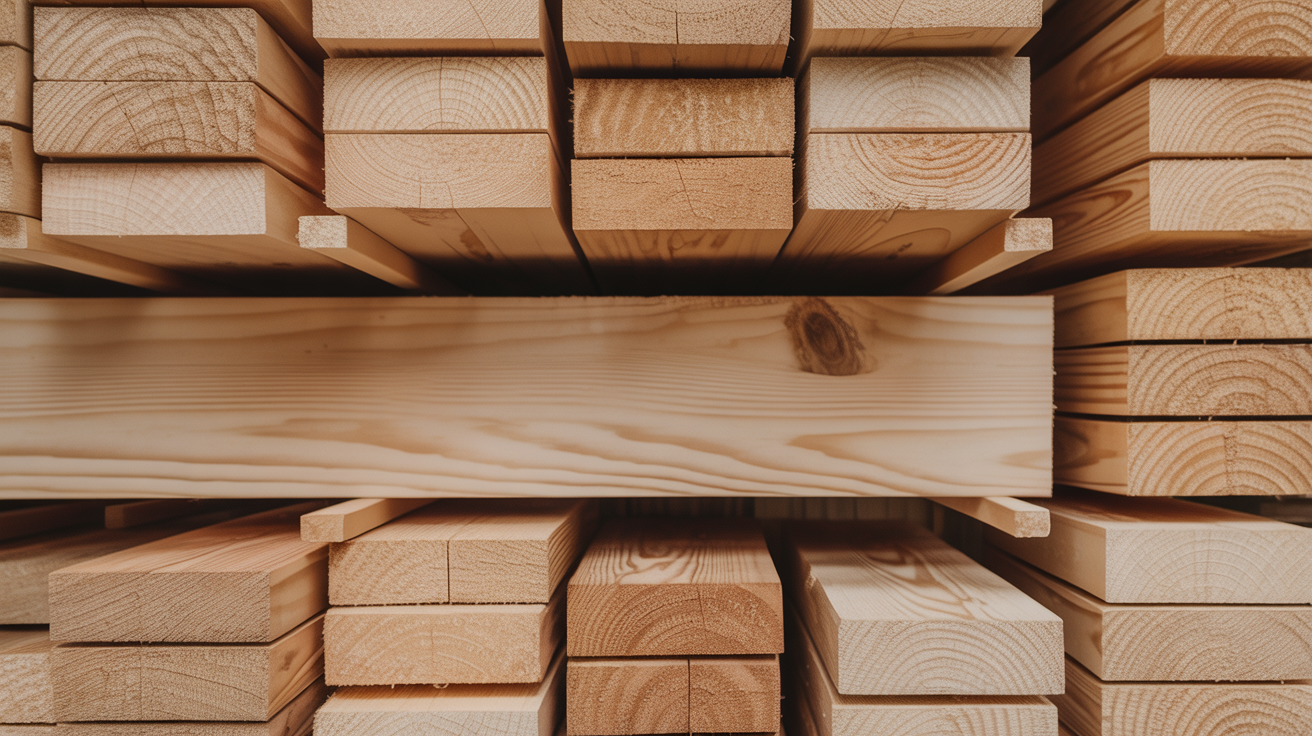
Walk into any lumber yard and ask for a 2x4, and you'll get a board that measures 1-1/2 inches by 3-1/2 inches. No one will explain this. The staff will hand it over, ring you up, and send you on your way. If you're building your first project based on plans that assume a true 2-inch thickness, that gap will cost you.
Understanding how lumber is sized and graded isn't arcane knowledge reserved for pros. It's just a set of conventions that made sense at one point in history and got locked in. Once you know them, buying the right wood for a project gets a lot easier.
At a Glance
- A "2x4" is really 1-1/2" x 3-1/2" after drying and planing; nominal sizes are never actual sizes for softwood dimensional lumber.
- Hardwood is priced by the board foot and sized in random widths; "4/4" means roughly 1 inch thick rough, "8/4" roughly 2 inches.
- Softwood grades (Select, No. 1 Common, Stud) describe appearance and knot size; hardwood grades (FAS, Select, No. 1 Common) describe how much clear, defect-free wood you can cut from the board.
- Budget 20-25% extra board feet for waste on clear stock, and 30-35% on figured or knotty wood.
- Kiln-dried softwood targets around 19% moisture content or below; furniture-grade hardwood targets 6-8%.
- Grading happens from the worst face of a board, so a No. 1 Common board can still have a clean, usable back.
Why Nominal Sizes Don't Match Actual Sizes
The disconnect between the number printed on a sign and the board in your hand goes back to how softwood lumber is processed. When a log is first cut at the mill, the rough sawn boards do come out close to the nominal dimensions. A 2x4 starts its life at something close to 2 inches thick. Then it gets kiln-dried to reduce moisture content, which causes the wood to shrink. After drying, the board runs through a planer to smooth the faces and give it a consistent thickness. That final planing step removes more material.
By the time the board reaches the yard, you've lost about half an inch off each dimension on larger stock. The industry standardized these final sizes decades ago, and they've stayed that way.
| Nominal Size | Actual Size |
|---|---|
| 1x2 | 3/4" x 1-1/2" |
| 1x3 | 3/4" x 2-1/2" |
| 1x4 | 3/4" x 3-1/2" |
| 1x6 | 3/4" x 5-1/2" |
| 1x8 | 3/4" x 7-1/4" |
| 1x10 | 3/4" x 9-1/4" |
| 1x12 | 3/4" x 11-1/4" |
| 2x2 | 1-1/2" x 1-1/2" |
| 2x4 | 1-1/2" x 3-1/2" |
| 2x6 | 1-1/2" x 5-1/2" |
| 2x8 | 1-1/2" x 7-1/4" |
| 2x10 | 1-1/2" x 9-1/4" |
| 2x12 | 1-1/2" x 11-1/4" |
| 4x4 | 3-1/2" x 3-1/2" |
These are standardized finished dimensions for softwood dimensional lumber: pine, fir, spruce, and similar species sold in home centers and big-box stores. Hardwoods follow a different system entirely. The chapter on commercial lumber in the U.S. Forest Service's Wood Handbook walks through both systems in detail if you want the full technical picture, but the practical version below covers what you actually need at the counter.
Softwood vs Hardwood: Two Different Measurement Worlds
Softwood dimensional lumber, the kind used for framing and most beginner projects, is sold by the linear foot using nominal sizes. You buy an 8-foot 2x4 and pay for 8 feet of it at that nominal size.
Hardwood is different. When you walk into a hardwood dealer to buy cherry or walnut or maple, the boards aren't sold in standardized widths. The mill cuts them as wide as the log allows, then sells them in random widths and lengths. Thickness is measured in quarters of an inch.
So "4/4 cherry" (said as "four-quarter") is a board that's roughly 1 inch thick in the rough. That's the full nominal thickness before surfacing. "8/4" is about 2 inches thick; "12/4" pushes toward 3 inches. Hardwood dealers also specify the surfacing state: S2S means surfaced on two sides (the faces are planed flat but edges are still rough), and S4S means all four sides have been milled smooth. Rough lumber gives you maximum thickness to work with but requires your own milling. S2S and S4S save setup time but yield less final thickness.
This matters practically. If you're building a small workbench and you want a top that finishes at 1-1/2 inches thick, rough 8/4 stock is a safer bet than finished 4/4. You have room to flatten, joint, and plane down to your target dimension. A common beginner mistake is buying 4/4 stock for a project that calls for a finished 7/8-inch thickness. There's no margin left to correct for a slightly cupped or twisted board, so you end up either accepting the defect or starting over with thicker stock.
How to Calculate Board Feet
Hardwood is sold by the board foot, not the linear foot. One board foot equals 144 cubic inches of wood, which works out to a piece 1 inch thick, 12 inches wide, and 12 inches long.
The formula:
Board feet = (thickness in inches x width in inches x length in inches) / 144
Or if your length is in feet:
Board feet = (thickness in inches x width in inches x length in feet) / 12
A worked example: You need four legs for a small side table, each 1-3/4 inches square and 28 inches long. You'd be milling these from 8/4 stock, so count the rough thickness as 2 inches.
- Thickness: 2"
- Width: 2" (you'll be ripping them down, but buy for the rough width)
- Length: 28"
- Board feet per leg: (2 x 2 x 28) / 144 = 112 / 144 = 0.78 bf per leg
- Four legs: 4 x 0.78 = 3.1 board feet
Add 20-25% for waste, defects, and the fact that boards rarely come in the exact lengths you need. Call it 4 board feet of 8/4 stock. At a typical retail price of $12-18 per board foot for figured walnut, you're looking at $48-72 for those four legs. That math helps you compare species and budget before you're standing at the counter.
A Second Worked Example: A Small Tabletop
Legs are simple because they're small parts. A panel glue-up is where board-foot estimates go wrong most often, because beginners forget to account for jointing waste. Say you're building a 20-inch by 30-inch tabletop from 4/4 cherry, finishing at 3/4 inch thick.
- Panel area: 20" x 30" = 600 square inches, or 4.17 square feet
- At 3/4" (rough count as 1" for 4/4 stock): 4.17 board feet, in theory
- Add 25% for jointing the edges straight and removing tearout: 5.2 board feet
- Add another 10-15% because boards in the width and length you need rarely exist in exact multiples, so you buy the next size up: roughly 6 board feet total
At $9-12 per board foot for flat-sawn cherry, that tabletop panel runs $54-72 in material before you've cut a single joint. Skipping the jointing-waste allowance is the single most common reason beginners come up short mid-project and have to make a second trip for a board that won't quite match the grain of the first.
If you're still setting up your space and tool kit, a solid reference point is what tools to buy first before you start hauling lumber home.
Softwood Grades: What the Numbers on the Tag Mean
Back in the softwood world, the tag stapled to a stud or board tells you its grade, which reflects the number and severity of knots, checks, and other natural defects.
Select grades are the clearest, most defect-free boards. "C Select" and "D Select" are the most common retail grades; C has fewer visible defects, D allows more but still looks clean from one face. These are what you want for furniture, shelving, or anything that will be stained and finished.
Common grades run from No. 1 through No. 4. No. 1 Common allows tight knots but is still structurally sound and usable for painted projects. No. 2 and below are construction grades, meant for framing where the wood will be hidden behind drywall. The knots are larger, the grain more irregular, and the appearance less predictable. Perfectly fine for a workbench, less appropriate for a dining table you're going to put in a living room.
Structural grades like "Stud," "Construction," and "Standard" are framing grades. You'll see these in bundles of 2x4s and 2x6s. They're graded for strength, not appearance.
Hardwood Grades: FAS, Select, and Common
The National Hardwood Lumber Association sets hardwood grades, and the terminology is different from softwood.
FAS (Firsts and Seconds) is the top grade. Boards must be at least 6 inches wide and 8 feet long, with the majority of the board free from defects. This is premium furniture-grade stock.
Select (sometimes written as "F1F" or "Selects") allows a few more defects on one face but is still a high-quality grade. For most furniture and cabinetry, Select gives you nearly as much clear wood as FAS at a lower cost.
No. 1 Common (also called "Cabinet" in some regions) yields less clear material per board but costs significantly less. Skilled woodworkers use No. 1 Common routinely by cutting around the defects. If you're making smaller parts like drawer fronts or door panels, you can often get clean pieces from cheaper stock and have very little waste.
Grading is done from the worst face, which means a board graded No. 1 Common might have a perfectly clear back face. Worth flipping the board at the dealer.
Quick Grade Comparison
| Grade | System | Clear Face Requirement | Typical Use |
|---|---|---|---|
| Select (C, D) | Softwood | Nearly defect-free | Furniture, shelving, trim |
| No. 1 Common | Softwood | Tight knots allowed | Painted projects, shop furniture |
| No. 2 and below | Softwood | Larger knots, irregular grain | Framing, hidden structure |
| FAS | Hardwood | 83-1/3% clear on the poorer face | Fine furniture, show surfaces |
| Select | Hardwood | Nearly FAS-quality on the good face | Furniture, cabinetry |
| No. 1 Common | Hardwood | 66-2/3% clear, cuttable around defects | Smaller parts, drawer fronts, painted work |
For a broader look at getting your workspace ready for projects like this, see how to set up a small garage workshop.
Moisture Content and Why It Matters
All of this sizing and grading assumes the wood has been properly dried. Kiln-dried (KD) softwood dimensional lumber targets around 19% moisture content or below. Hardwoods destined for furniture are typically dried to 6-8% for interior use, a range the Forest Products Laboratory's Wood Handbook documents in its chapter on drying and moisture control, along with how quickly different species pick up or shed moisture once they leave the kiln.
Wood moves as its moisture content changes relative to the surrounding environment. A board that comes in wet and then dries in your shop will shrink across the grain, which means it can crack glue joints or pull panel joints apart. "Air dried" stock is cheaper but less predictable, often settling in the 12-20% range depending on climate and how long it sat in the yard. If you're building furniture, stick with properly kiln-dried material and let it acclimate in your shop for a few days before milling.
That said, even kiln-dried boards can pick up moisture in a damp lumber yard. Check for cupping, bowing, or surface checking when you select boards. Sight down the length from one end. Small amounts of warp are workable if you have the rough thickness to flatten it out; a badly twisted 4/4 board leaves you almost nothing to work with. As a rule of thumb, if you can't hold the twist out with light hand pressure, don't buy the board for anything that needs to stay flat.
If you're just starting out and working through how all of this fits together practically, this overview of getting started in woodworking covers the early decisions in more depth.
Frequently Asked Questions
Why does my lumber yard label boards with nominal sizes if they're never actually that size?
The nominal system is a holdover from when rough-sawn lumber was sold without surfacing. The names stuck even after milling became standard. At this point the industry, building codes, and decades of plans all reference nominal sizes, so changing the labels would create more confusion than it solves.
Can I buy actual 2x4 lumber that's truly 2 inches by 4 inches?
Yes, from specialty mills or rough-sawn suppliers. Ask for "rough sawn" or "full sawn" lumber. It will arrive with saw marks on the surface and close to the true dimensions, but you'll need to joint and plane it yourself to get flat, consistent faces. Some timber framers and heavy workbench builders prefer it for that reason.
How do I know how many board feet to buy for a project?
Cut a rough parts list: every component with its finished dimensions. Add the waste factor (15-25% is reasonable for clear stock; push toward 30-35% for knotty or figured wood where you're cutting around defects). Add up the total board feet and cross-reference with what the dealer actually stocks in terms of board widths and lengths, since you can't always get exactly the size you calculated.
Is there a meaningful quality difference between big-box store lumber and a specialty hardwood dealer?
For framing and painted construction work, big-box lumber is perfectly adequate. For furniture and fine woodworking, the hardwood dealer wins on selection, drying quality, and the ability to handpick boards. Home centers usually carry only a few hardwood species (red oak, poplar, maybe pine), and the boards are often too wet or poorly dried for furniture. A local hardwood dealer lets you sort through the pile.
What does "S4S" mean on a hardwood price list?
Surfaced four sides. The board has been run through a planer (smooth faces) and jointer (straight edges), so it's already at a consistent thickness and close to square. It's ready to cut to length and glue up without additional milling. Rough lumber costs less but requires a jointer and planer to flatten and true up. If you don't have those tools yet, S4S stock lets you start building sooner.
Why do two boards of the same grade sometimes look so different?
Grading rules set minimums, not a fixed appearance. NHLA grades are based on the percentage of clear, usable material a board yields, not on color, figure, or how the grain looks. Two FAS boards can be graded identically and still differ wildly in color and figure, since those qualities aren't part of the formal grading criteria. If appearance matters as much as yield, plan to handpick boards in person rather than ordering by grade alone.
Does a higher grade always mean a stronger board?
Not necessarily. Structural softwood grades like Stud and Construction are rated for strength, factoring in knot size and location relative to the load path. Appearance grades like Select and FAS are rated for clear yield, not strength. A Select board with a well-placed sound knot can be just as strong as a clear one; it's simply graded lower because the knot affects appearance, not because it's a weaker piece of wood.