Power Tools
Choosing Your First Cordless Drill
A plain cordless drill buying guide for beginners: voltage, chuck size, brushless vs brushed, battery platform, and what to skip.
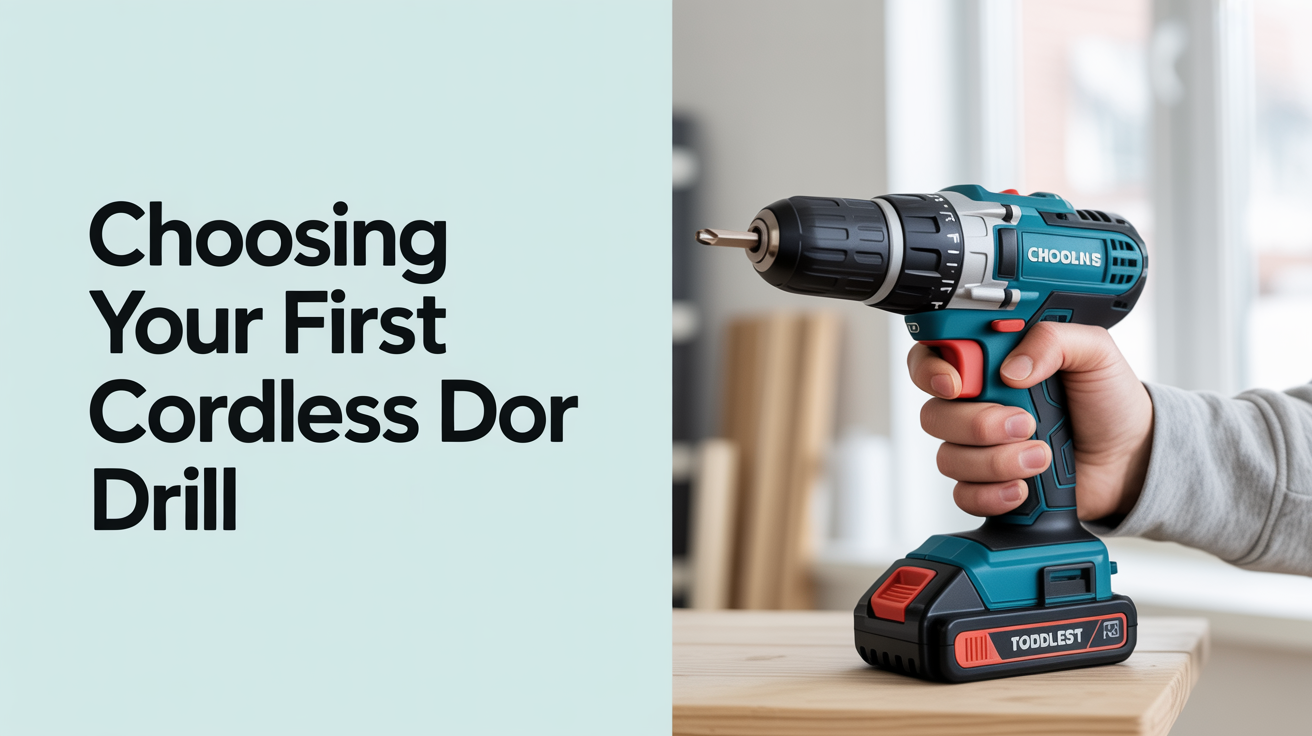
A cordless drill is the first power tool most woodworkers buy, and for good reason: it handles pilot holes, drives screws, and mixes finish in the same afternoon. This guide explains the specs that matter so you can pick one that will still feel right two years from now.
Drill vs Driver: Getting the Terms Straight
The phrases "drill" and "driver" get used interchangeably in stores, but they describe different actions.
A drill spins a bit in a continuous circle. It bores holes in wood, metal, and masonry. The clutch ring around the chuck lets you set a torque limit so you stop before snapping a screw head.
A driver (specifically an impact driver) delivers short rotational bursts rather than steady spinning. It excels at driving long screws and lag bolts without stripping heads, but it lacks a proper clutch and is harder to control when drilling clean holes.
For a first tool in a woodworking shop, a drill/driver combo is the right starting point. You get the clutch control for furniture screws and enough torque for most drilling tasks. If you later find yourself driving dozens of 3-inch screws into framing lumber, an impact driver becomes worth considering as a second tool.
Drill Voltage Explained
Voltage is the number you see most prominently on the label. A higher voltage means a more powerful motor, but it also means a heavier battery. Here is what each range is actually suited for:
| Voltage | Weight class | Good for |
|---|---|---|
| 12V | Compact, light | Cabinetry, light joinery, overhead work |
| 18V / 20V max | Standard | General woodworking, decking, most DIY |
| 24V or higher | Heavy duty | Framing, masonry, production use |
The 18V and 20V labels refer to the same class of battery. Manufacturers measure peak voltage differently, but these drills are functionally equivalent. An 18V/20V drill handles nearly every woodworking task a beginner will encounter, including drilling through hardwoods, driving cabinet screws, and countersinking for pocket holes.
A 12V drill is a legitimate choice if you mainly work on small boxes, frames, or built-ins where reaching into tight spaces matters. It is noticeably lighter, which reduces fatigue during long assembly sessions.
Skip the 24V and higher options for now. They are heavier, the batteries cost more, and the extra power rarely matters for wood. If you later expand into concrete or heavy structural work, you can reassess.
Brushless vs Brushed Motors
Older drill motors use carbon brushes to transfer electricity to the spinning armature. Newer motors eliminate the brushes entirely by using electronic controllers instead.
Brushed motors are less expensive to manufacture, so drills using them cost less up front. They generate more heat at sustained loads, and the brushes wear down over years of use. For occasional hobby woodworking, a brushed drill will still last a long time.
Brushless motors run cooler, extract more usable work from each battery charge, and tend to have longer service lives. The price premium has shrunk considerably in recent years. If two otherwise comparable drills are close in price, choose the brushless one.
One practical difference worth knowing: brushless drills often have an electronic brake that stops the bit almost instantly when you release the trigger. That feature is useful when drilling near layout lines or stopping flush to a shoulder.
Chuck Size and Key Features
Chuck size
Most drills sold today have either a 3/8-inch or 1/2-inch chuck. The number describes the maximum shank diameter the chuck can grip.
A 3/8-inch chuck handles the bits used in most woodworking: twist bits, spade bits up to about 1 inch, brad-point bits, countersink sets, and driver bits. For a first drill, 3/8 inch covers everything you are likely to do in the first few years.
A 1/2-inch chuck opens up access to larger spade bits, hole saws, and specialty cutters. If you plan to bore large holes frequently, or you will share the drill with plumbing and electrical tasks around the house, the 1/2-inch chuck gives you more flexibility.
All current drills use keyless chucks that tighten by hand. You do not need a separate chuck key.
Clutch settings
The clutch ring on the front of the drill has numbered positions. Higher numbers allow more torque before the clutch disengages; lower numbers are gentler and stop the bit before overdriving a screw. More clutch positions give you finer control. Anything with ten or more positions is sufficient for furniture-scale work.
Speed settings
Most drills offer two gear ranges: a slow, high-torque range for driving screws and a faster range for drilling holes. A few models add a third range. Two speeds are plenty. The key question is the actual RPM figure in each range. For drilling into hardwood, you want the fast range to reach at least 1,400 to 1,500 RPM.
Handle and grip
Try to hold the drill before buying if the option exists. A grip that feels balanced at the store will feel much better after an hour of assembly. Top-heavy drills cause hand fatigue faster.
Battery Platform: The Long-Term Decision
The battery is often worth more than the drill itself, and batteries are not interchangeable across manufacturers. When you buy a second tool later, matching the battery platform means your existing batteries work in both tools. That is one reason many woodworkers commit to a single brand for all their cordless tools.
What to look for in the battery that ships with the drill:
- Amp-hours (Ah): A higher Ah rating stores more energy and runs longer between charges. For general woodworking, a 2.0 Ah or 4.0 Ah pack is a reasonable starting point.
- Kit contents: Many drills are sold as a kit with one or two batteries and a charger. A two-battery kit means you can charge one while using the other.
- Charger speed: Standard chargers can take over an hour. Some platforms offer rapid chargers that top up a pack in 30 to 45 minutes. The charger type matters more once you own multiple tools.
Because the battery platform is a long commitment, it is worth checking whether the brand you choose has a range of other tools, such as circular saws, sanders, and routers, in the same voltage family. Expanding into those tools later costs less when you already own compatible batteries.
What to Skip as a Beginner
A few features sound appealing in marketing copy but rarely add practical value for a first drill:
- Extremely high torque ratings beyond 600 in-lb rarely come into play in woodworking. The number does not tell you much about how the drill feels in practice.
- Built-in work lights on inexpensive drills can be dim and poorly positioned. A clip-on task light does a better job.
- Hammer mode on a drill/driver is useful for masonry but adds bulk and weight. If you need to drill concrete occasionally, a hammer mode is a bonus. If your work is entirely wood, skip it or treat it as a secondary factor.
For pairing ideas on other tools worth adding to your shop after the drill, see circular saw basics for accurate cuts and getting started with a random orbital sander. When you are ready to cut joinery with a router, how to use a router: a beginner's guide walks through the setup.
Frequently Asked Questions
Do I need both a drill and an impact driver right away?
No. Start with a drill/driver. It handles screws and holes well enough for all furniture-scale work. An impact driver becomes a meaningful addition once you're regularly driving long screws or working on structural projects.
Is 18V enough for hardwoods like oak and maple?
Yes, for the hole sizes used in woodworking. An 18V drill with a sharp brad-point or Forstner bit bores through hard maple cleanly. Where you run into limits is with large hole saws above 2 inches in diameter, and those are niche situations for most projects.
What does "20V max" mean compared to "18V"?
Both labels describe the same practical voltage class. "20V max" refers to the no-load peak voltage of the battery cells. The working voltage under load is the same as an 18V battery. The tools and batteries from both labeling conventions are not cross-compatible, but their performance is comparable.
How long does a cordless drill battery last?
Under normal hobby use, a lithium-ion battery pack tends to hold adequate capacity for three to five years before you notice a real drop in runtime. Storing batteries at room temperature and avoiding full discharge extends that. Most manufacturers sell replacement packs that fit older tools in their platform.
Can I use my drill as a sander or router?
Drill-powered sanding drums and drum sander attachments exist and work for rough shaping. They are not a substitute for a dedicated random orbital sander on flat panels. A drill cannot replace a router at all. The rotation speed and collet precision required for router bits are not compatible with drill chucks.