Power Tools
How to Use a Miter Saw for Accurate Crosscuts
Learn to set up and safely operate a miter saw for repeatable 90-degree crosscuts and 45-degree miters. Step-by-step guide for beginners.
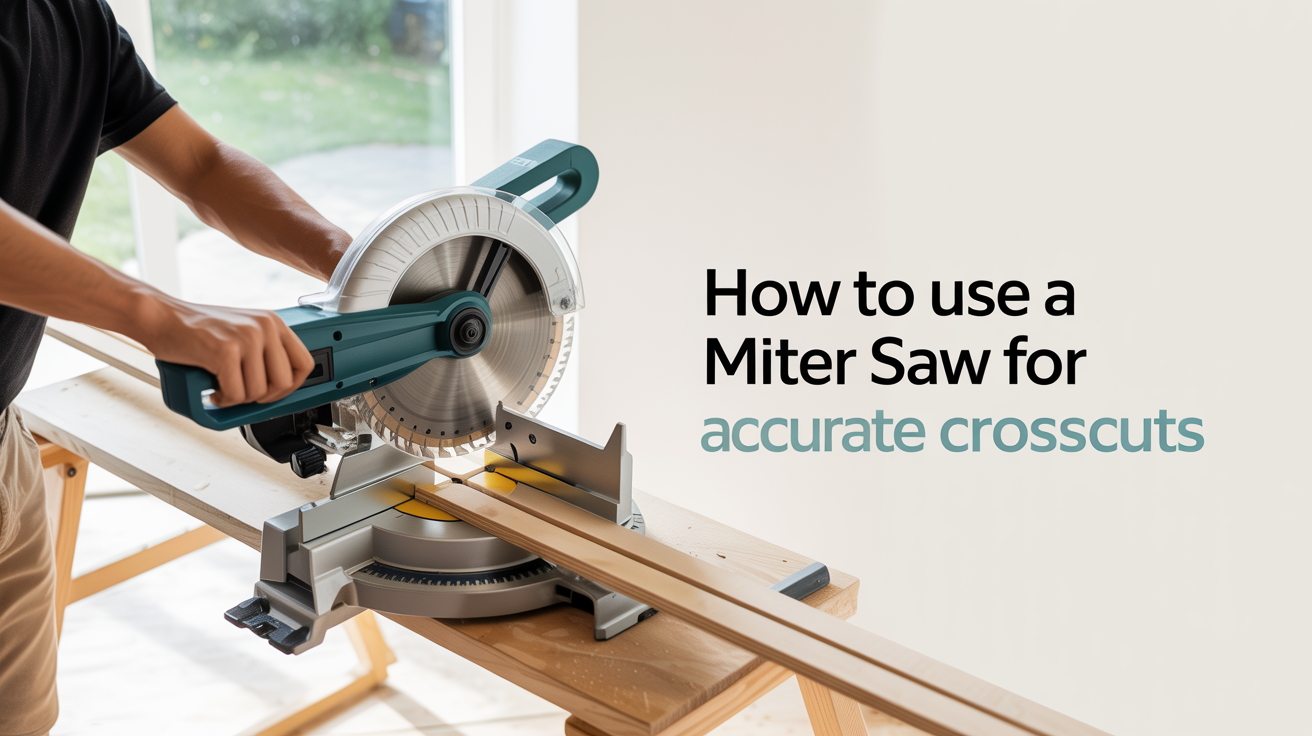
A miter saw makes accurate, repeatable crosscuts faster than almost any other shop tool. Once you understand how the fence, scales, and blade guard work together, you can cut a board to length or frame a picture-perfect 45-degree corner without much fuss.
Understanding the Machine Before You Switch It On
A compound miter saw has three basic adjustments: the miter angle (the head rotates left and right), the bevel angle (the head tilts side to side), and the depth of cut. Most saws detent at the most-used angles, 0, 22.5, and 45 degrees on both scales, so they click into position with light hand pressure.
Parts you should know:
- Fence: The tall, flat backstop your workpiece rests against. It keeps the board perpendicular to the blade. Some fences have a gap in the middle; your board should span that gap and contact both fence sections.
- Blade guard: A clear or opaque plastic shroud that covers the blade. It retracts automatically as you lower the head. Never remove or defeat it.
- Hold-down clamp: A small clamp mounted to the fence that locks narrow stock in place. Use it whenever the workpiece might shift.
- Kerf reference lines: Most saws have lines scribed on the table surface to show where the blade will exit the cut. Learn which side of those lines is the kerf before you cut anything you want to keep.
If you are building out your shop from scratch, the miter saw often appears on the short list of first purchases. See The Beginner Woodworking Tool Kit Worth Buying First for how to prioritize your budget.
Setting Up a Square 90-Degree Crosscut
A 90-degree crosscut is the cut you will make nine times out of ten. Getting it dialed in is worth five minutes of setup.
Step 1: Confirm the miter scale reads zero. Press the detent pin and rotate the head until it clicks at 0 degrees. Check the indicator against the scale. If it does not read zero, loosen the scale lock (usually a knob at the front of the table) and nudge it until the pointer lines up.
Step 2: Confirm the bevel reads zero. Tilt the head and release it so it seats at 0 degrees on the bevel scale. Run a reliable square against the fence and the flat of the blade (not the teeth). The blade should be perfectly vertical. Adjust the bevel stop screw if it is off.
Step 3: Test on scrap. Cut through a piece of 2x4 scrap and check both the face and the edge with a square. If either shows a gap, trace which adjustment is out and correct it before moving on.
Making the cut:
- Mark your cut line with a sharp pencil and a square.
- Place the board flat on the table, tight against the fence.
- Position the blade so the kerf falls on the waste side of your line.
- Hold the board firmly with your free hand at least six inches from the blade path.
- Squeeze the trigger and let the blade reach full speed before you lower it through the wood.
- Pull the blade all the way through in a smooth, steady stroke. Do not rush the downstroke.
- Wait for the blade to stop completely before you raise the head. This is one of the most skipped safety steps. A spinning blade rising through the cut can catch the offcut and throw it.
Cutting 45-Degree Miters for Frames and Trim
Picture frames, door casings, and baseboard corners all require 45-degree miters. The miter saw handles these cuts more accurately than a hand saw and more repeatably than a circular saw.
Setting the angle:
Press the detent and rotate the head to 45 degrees left or right (the direction determines which face is the long point). The scale should click and lock. Verify with a reliable drafting triangle if your project needs precision. Two 45-degree cuts joined together should form a square 90-degree corner.
Sneaking up on the fit: Miters for a frame rarely land perfect on the first cut. Start by cutting all four pieces slightly long, then take thin passes off each miter until the joints close without gaps when you hold them together by hand. A thin shaving off a 45-degree face makes a big difference at the corner, so go slowly at the end.
Bevel cuts: A bevel angle tilts the blade sideways instead of rotating the head. A compound cut uses both together, common in crown molding. For plain picture frames, keep the bevel at zero and adjust only the miter.
Stop Blocks for Repeatable Lengths
If you need to cut five boards to the same length, a stop block saves time and eliminates the error that piles up when you mark each board individually.
A stop block is just a piece of scrap clamped to the fence (or to a fence extension) at a measured distance from the blade. Each board butts against the block, and every cut lands in the same place.
How to set one:
- Make one reference cut on a scrap piece.
- Measure from the fence to the blade on the clean end of that scrap. If you want pieces 18 inches long, add or subtract until the distance matches.
- Clamp the stop block to the fence with a C-clamp or a purpose-built stop-block clamp.
- Cut a test piece and check the length with a tape measure before you run your good stock.
A stop block also reduces the chance of kickback because the board cannot creep while you lower the blade.
How the Miter Saw Compares to the Circular Saw
Both tools cut wood across the grain, but they suit different situations.
| Factor | Miter Saw | Circular Saw |
|---|---|---|
| Accuracy on short crosscuts | Excellent, fenced and guided | Good with a square guide, less so freehand |
| Portability | Heavy, stays on the bench | Handheld, goes to the job site |
| Maximum board width | Limited by blade diameter (typically 8-12 in.) | Can crosscut wide sheet goods |
| Angled cuts | Fast detents, repeatable | Requires careful layout and guides |
| Setup time | Fast once calibrated | Minimal for a single cut |
| Long rip cuts | Cannot do them | Can rip with a rip-fence accessory |
The miter saw wins for cutting framing lumber, trim, and project parts to length in the shop. The circular saw wins when you are cutting full sheets of plywood or working on-site without a bench. For a deeper look at handling a circular saw accurately, see Circular Saw Basics for Accurate Cuts.
If you also need to rip lumber along the grain, that job belongs to the table saw. Getting that tool dialed in properly is a separate skill set covered in Table Saw Safety and Setup for Beginners.
Clamping Narrow Stock Safely
Boards narrower than about three inches are tricky to hold with your free hand without getting it too close to the blade. Use the built-in hold-down clamp or a small toggle clamp mounted to the fence extension. The board should not be able to walk or lift during the cut.
Do not hold short offcuts against the fence. A piece shorter than about six inches can get caught between the blade and the fence. Let short offcuts fall free. They are scrap; do not chase them with your hand.
Frequently Asked Questions
Do I need to clamp the miter saw to the workbench? It is a good habit, especially if the saw sits on a portable stand. An unclamped saw can walk backward during repeated cuts. Four lag bolts through the base flanges into a solid bench or stand is the most secure setup.
Why does my miter saw leave a rough or splintery cut? Usually a dull blade or the wrong blade for the job. A crosscut blade (typically 60-80 teeth on a 10-inch saw) leaves a cleaner surface than a framing blade (24-40 teeth). The blade should also be running at full speed before it contacts the wood.
Can I cut metal or plastic with a miter saw? Only with a blade designed for that material. A wood blade running through aluminum or PVC can shatter and throw fragments. Non-ferrous metal and plastic require dedicated blades, slower feed rates, and often a different saw altogether. Stick to wood with your shop saw unless the manual explicitly approves other materials.
How do I know which direction to rotate the head for a left or right 45-degree miter? Hold your workpiece as it will sit in the finished assembly and think about which corner is which. For a four-sided frame, opposite corners share the same miter direction. It helps to label each piece (top, bottom, left side, right side) and sketch the cut orientation on paper before you make your first cut.
My two 45-degree cuts do not close up into a tight corner. What is wrong? Check that both cuts actually read 45 degrees on the scale. If the scale is right, the issue is usually that one board was not held flat on the table or firmly against the fence during the cut. Even a small lift or gap between the board and the fence will throw the angle off. Re-cut on fresh scrap with deliberate pressure against both the fence and the table surface.